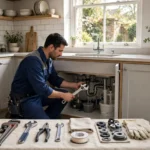
A plumbing problem rarely arrives at a convenient moment. A burst pipe, a boiler that gives up in January, a drain that will not clear: in the stress of the moment, most people hire the first person who answers the phone. Learning how to choose a reliable plumber before an emergency happens is one of the most valuable pieces of home maintenance knowledge you can have. The right tradesperson protects your home and your wallet; the wrong one can turn a small leak into an expensive disaster. Here is how to tell the difference.
Check Qualifications and Registration First
Plumbing in the UK is not as tightly licensed as gas work, which makes your own checks more important, not less. For anything involving gas or a boiler, the engineer must be on the Gas Safe Register, and you can verify their ID card number online in minutes. For general plumbing, look for recognised qualifications such as an NVQ or City & Guilds certificate, and membership of a professional body like the Chartered Institute of Plumbing and Heating Engineering. A reliable plumber will never be offended by being asked. If someone is vague about their training, cannot produce insurance details, or pressures you to decide immediately, treat that as your answer and look elsewhere.
Ask for Proof of Insurance and a Written Quote
Any plumber working in your home should carry public liability insurance, and a professional will happily show you the certificate. It protects you if something goes wrong, from a flooded floor to a damaged fitting. Just as important is the paperwork for the job itself. Ask for a written quote that separates labour, parts and call-out charges, and states whether the price is fixed or an estimate. Verbal prices have a habit of growing. For larger jobs, get two or three quotes and compare what is actually included, not just the headline figure. The cheapest quote that excludes parts, VAT or making good afterwards is rarely the cheapest job. Keeping clear records of quotes and completed work matters for your home in the same way a car’s service history matters when you come to sell it.
Read Reviews Like an Investigator
Online reviews are useful, but only if you read them properly. Look for detail: reviewers who describe the actual problem, how the plumber communicated, whether they arrived on time and whether the fix lasted. A long run of specific, recent reviews across more than one platform is a good sign. Be cautious with a page of identical five-star comments posted in the same week, and equally cautious about dismissing a plumber over one angry review with no specifics. Check how the business responds to criticism, too. A calm, professional reply to a complaint tells you a great deal about how they will treat you if something goes wrong with your job.
Judge the First Conversation
You can learn a lot before any tools come out. A reliable plumber asks questions about the problem, explains the likely causes in plain language, and talks you through options, including the option of a simpler repair. They will give you a realistic arrival window and tell you the call-out terms upfront. Compare that with the way a good garage earns trust: our guide to what makes a great garage describes the same pattern of clear diagnosis, honest pricing and proper records, and it applies to tradespeople of every kind. Vague answers, cash-only demands and reluctance to put anything in writing are all reasons to keep looking.
Understand How Plumbers Charge
Most plumbers charge either an hourly rate, a fixed price per job, or a higher emergency rate for out-of-hours work. None of these is automatically best; what matters is knowing which applies before work starts. Ask what the first hour costs, whether parts are marked up, and what happens if the job takes longer than expected. For planned work rather than emergencies, fixed quotes are usually easier to budget for. Some households prefer spreading maintenance costs through service arrangements, much as drivers weigh up whether car service plans are worth it; the same logic of predictable costs versus pay-as-you-go applies to looking after a home.
Plan Ahead So Emergencies Stay Small
The cheapest plumbing job is the one you never need. Learn where your stopcock is and test that it turns. Get dripping taps and slow drains dealt with while they are still minor, and have your boiler serviced annually rather than waiting for it to fail in cold weather. Planned maintenance always beats emergency repair, in homes just as much as in cars, where jobs like timing belt replacement are far cheaper done on schedule than after a breakdown. Finally, keep the number of a plumber you have already checked and trust saved in your phone. When water is coming through the ceiling, that is not the moment to start reading reviews.
Choosing a reliable plumber comes down to a handful of habits: verify qualifications and Gas Safe registration where it applies, insist on insurance and written quotes, read reviews for specifics, and judge how clearly they communicate from the very first call. Do those checks once, on a calm day, and you will have someone you can trust on the worst day. Your home is probably the most valuable thing you own; the people you let work on it should be chosen with the same care as the people you trust with anything else you rely on every day.
Questions to Ask Before You Agree to Anything
A short conversation before work begins prevents most disputes. Ask how long the job should take, what could make it take longer, and whether the price covers making good afterwards, such as refitting a bath panel or resealing around a repair. Ask what guarantee covers the work and how long it lasts, and whether the parts fitted carry their own manufacturer’s warranty. Ask who will actually do the work, since some firms send subcontractors you have never spoken to. Finally, ask how they would like to be paid and when; a deposit for materials on a large job is normal, but full payment in advance is not. A reliable plumber will answer every one of these questions without hesitation, and the answers, noted down, become the reference point for the whole job.
One last source of reassurance is your own network. Ask neighbours, local friends or a community group who they use and, just as importantly, who they would avoid. Personal recommendations carry a weight that no review platform can match, because the person giving them has watched the work age. A plumber whose name comes up repeatedly, for the right reasons, over several years is rarely a bad choice.