Hybrid servicing is becoming an increasingly important part of vehicle maintenance in the UK as more motorists choose cars that combine an internal combustion engine with electric drive technology. Hybrid vehicles can reduce fuel consumption in suitable driving conditions, but they still require regular maintenance to keep their mechanical and electrical systems operating correctly.
For hybrid owners, servicing involves more than checking the engine. A suitable workshop may also need to assess the hybrid battery system, electrical components, braking system, cooling systems, tyres and vehicle diagnostics. Understanding these requirements can help owners choose the right service provider and maintain their vehicle over the long term.
What Does Hybrid Servicing Involve?
Hybrid servicing covers many of the same basic maintenance tasks found on conventional vehicles, but it also considers the additional electrical systems used by hybrid powertrains.
A typical service can include checks of engine fluids, filters, brakes, tyres, suspension, steering, lights and other conventional components. Depending on the vehicle and manufacturer schedule, technicians may also inspect the hybrid battery, electrical connections, cooling systems and relevant diagnostic information.
The exact requirements vary between models. Hybrid technology is not identical across manufacturers, so owners should follow the maintenance schedule specified for their particular vehicle.
This is one reason why selecting a workshop with appropriate hybrid knowledge can be important, particularly when the work involves high-voltage components.
Why Hybrid Servicing Matters for Vehicle Owners
Regular hybrid servicing helps identify maintenance issues before they become more serious. Although hybrid vehicles use electric motors and batteries, they still contain conventional mechanical components that experience normal wear.
Brakes, tyres, suspension components, fluids and the combustion engine can all require attention. At the same time, the hybrid system introduces additional components that need suitable diagnostic and inspection procedures.
Keeping a complete service history can also make it easier to understand the vehicle’s maintenance condition when it is sold or transferred to another owner.
For motorists considering a hybrid vehicle, understanding these maintenance requirements should form part of the ownership decision rather than being treated as an afterthought.
How Hybrid Battery Technology Changes Maintenance
Battery technology is one of the main differences between hybrid vehicles and conventional petrol or diesel cars. A hybrid battery stores electrical energy and works with the vehicle’s electric motor and control systems.
Not every battery-related concern means that the complete battery pack needs replacing. Diagnostic testing can help technicians identify whether an issue involves the battery, electrical connections, cooling system, control electronics or another component.
High-voltage systems also require appropriate safety procedures. UK government guidance for MOT testers explains that hybrid and electric vehicles can use high-voltage systems, while repairs involving those systems require recognised training.
That distinction is important. A workshop may be able to perform routine maintenance on a hybrid vehicle without undertaking high-voltage repairs, but specialist work requires the appropriate competence and equipment.
Toyota Hybrid Service and Maintenance
The Toyota is one of the most established hybrid vehicle manufacturers, and its UK servicing programme provides a useful example of how manufacturer-specific hybrid maintenance can work.
Toyota UK states that its hybrid service includes checks of the hybrid system and hybrid battery. Toyota also recommends servicing a hybrid vehicle every 12 months or 10,000 miles, whichever comes first, although individual vehicle requirements can differ.
For owners of Toyota hybrid models, a Toyota dealer or another appropriately equipped workshop can therefore be considered when deciding where to maintain the vehicle.
Toyota also provides service plans and manufacturer-trained technicians through its dealer network. Its current UK servicing information explains that qualifying services can provide additional warranty cover subject to the relevant terms and conditions.
This illustrates why manufacturer-specific requirements should be checked before booking hybrid maintenance. The recommended schedule and available servicing benefits can vary according to the vehicle, age and service history.
Do Hybrid Cars Need Regular Engine Servicing?
Yes. A hybrid vehicle with a combustion engine still has an engine that requires appropriate maintenance.
The electric motor can reduce how frequently the engine operates under certain driving conditions, but it does not eliminate the need for engine maintenance. Oil, filters, cooling systems and other components still need to be maintained according to the manufacturer’s schedule.
Hybrid ownership should therefore not be viewed as maintenance-free motoring. Instead, the maintenance profile changes because responsibility is shared between conventional mechanical systems and electric drive technology.
Hybrid Brakes and Regenerative Braking
Hybrid vehicles can use regenerative braking to recover some kinetic energy and convert it into electrical energy. This can alter how the braking system is used compared with a conventional vehicle.
Reduced use of friction brakes under some driving conditions may affect the rate at which brake components wear. However, brake inspection remains important because discs, pads and related components still need to remain in suitable condition.
Brake performance should never be judged solely by apparent pad wear. A qualified technician should assess the complete braking system during relevant maintenance and safety inspections.
Hybrid Servicing and Tyre Maintenance
Tyres remain a fundamental part of hybrid vehicle maintenance. Correct tyre pressure, tread condition, wheel condition and alignment can affect safety, handling and efficiency.
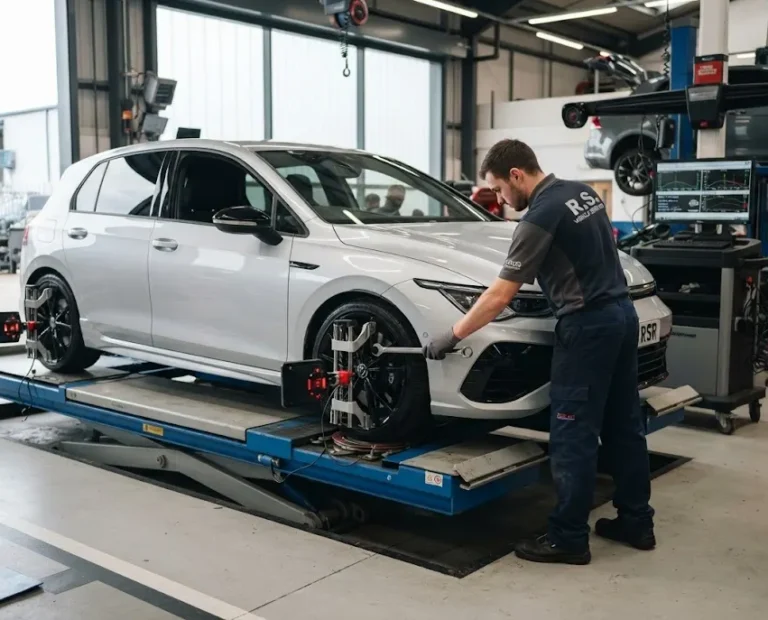
Incorrect wheel geometry can also contribute to uneven tyre wear. If a hybrid vehicle develops steering or handling symptoms, owners may need to investigate wheel alignment as part of the wider maintenance process.
Tyre maintenance is particularly important because hybrid vehicles can have different weight distributions depending on their battery configuration and vehicle design. The correct tyre specification should always be checked against the manufacturer’s requirements.
Finding the Right Hybrid Service Provider
Not every garage offers the same level of hybrid expertise. Owners should consider the workshop’s equipment, technician training and experience with the specific vehicle technology.
Useful questions before booking can include:
- Does the garage regularly service hybrid vehicles?
- Does it have suitable hybrid diagnostic equipment?
- Are technicians trained to work with high-voltage systems?
- Can the workshop follow the manufacturer’s service schedule?
- Does it provide clear information about recommended repairs?
- Can it carry out additional conventional maintenance such as brakes, tyres and suspension work?
For routine work, a reputable independent garage may be suitable if it has the required knowledge and equipment. For complex manufacturer-specific repairs, an authorised workshop may offer additional technical resources.
This fits into the wider UK market of automotive service companies, where independent garages, authorised workshops and national service networks compete across different vehicle technologies.
Hybrid Ownership and Long-Term Maintenance
Hybrid ownership involves considering both conventional vehicle maintenance and electrical technology. This does not necessarily make ownership complicated, but it does mean that service decisions should be based on the vehicle’s actual requirements.
Keeping scheduled maintenance up to date can help owners identify developing problems and maintain a useful service history. It can also help technicians monitor the condition of components that may become more important as the vehicle ages.
Battery condition is naturally a major consideration for long-term hybrid ownership. However, owners should avoid assuming that a particular mileage automatically determines battery failure. Battery life can depend on the vehicle design, operating conditions, age, maintenance and other factors.
Hybrid Servicing Costs
The cost of hybrid servicing varies significantly between models, manufacturers, service levels and workshops. Routine servicing may involve many of the same maintenance items found on conventional cars, while specialist diagnostics or repairs can add costs.
Toyota’s current UK service pricing, for example, lists different prices according to vehicle category and service level rather than applying one universal hybrid servicing price.
Owners should therefore compare like-for-like service schedules rather than choosing a workshop based only on the headline price. A cheaper service may not include the same inspections or manufacturer-specific checks.
Hybrid Vehicles and Sustainable Transport
Hybrid vehicles occupy an interesting position within the transition towards lower-emission transport. They combine an internal combustion engine with electric propulsion rather than relying exclusively on a battery-electric powertrain.
The UK government recognises several types of alternatively fuelled vehicles, including hybrid electric vehicles, plug-in hybrid electric vehicles and battery electric vehicles.
This means hybrid vehicles can form part of a broader mobility transition while still requiring maintenance expertise familiar with conventional engines and electrical systems.
For drivers who are not ready to move directly to a fully electric vehicle, hybrid ownership can provide an alternative powertrain. However, the suitability of a hybrid depends on driving patterns, vehicle choice, budget and individual requirements.
Hybrid Servicing Safety Considerations
High-voltage components require special attention when repairs go beyond routine maintenance. Government guidance states that high-voltage systems in hybrid and electric vehicles can operate at hundreds of volts and that repairs to those systems should only be undertaken by appropriately trained personnel.
For ordinary motorists, this means there is no reason to attempt DIY repairs on high-voltage hybrid components. Warning messages, electrical faults or suspected battery problems should be assessed by a suitably qualified professional.
Technicians also need to follow appropriate procedures when inspecting or repairing damaged vehicles. Safety requirements can differ depending on the vehicle system and the nature of the work.
How Hybrid Servicing May Evolve
As hybrid vehicles become an established part of the UK vehicle parc, service networks are likely to continue expanding their technical capabilities. Workshops may invest in training, diagnostic equipment and safety procedures to handle a wider range of hybrid systems.
The industry will also need to accommodate multiple generations of technology. Older hybrid systems may coexist with newer plug-in hybrids and increasingly sophisticated electrical architectures.
This creates opportunities for both national garage chains and independent specialists. Businesses that understand the technology and communicate their capabilities clearly can build trust with hybrid owners.
The development of hybrid servicing also provides a bridge towards broader electric vehicle maintenance. As workshops gain experience with batteries, diagnostics and high-voltage safety, those capabilities can become relevant to the growing EV market as well.
Conclusion
Hybrid servicing is an important part of modern vehicle maintenance, combining conventional mechanical care with additional checks associated with electric drive systems. Owners still need regular attention to engines, brakes, tyres, suspension and other traditional components, while hybrid batteries and high-voltage systems introduce additional technical considerations.
Toyota hybrid service programmes demonstrate how manufacturers can provide dedicated maintenance and hybrid system checks, while independent garages and wider service networks can also play an important role when they have the right training and equipment.
For motorists, the most sensible approach is to follow the vehicle manufacturer’s maintenance schedule and choose a workshop capable of performing the required work safely. As sustainable transport and vehicle electrification continue to develop, hybrid expertise is likely to remain an important capability across the UK automotive service industry.