Wheel alignment is an important part of vehicle maintenance because it affects how a car’s tyres contact the road, how the vehicle responds to steering inputs and how evenly the tyres wear. When alignment is incorrect, drivers may notice the car pulling to one side, an off-centre steering wheel or unusual tyre wear.
For UK motorists, wheel alignment can become particularly relevant after hitting potholes or kerbs, replacing tyres, carrying out suspension work or noticing changes in handling. Correct alignment helps the vehicle maintain the intended relationship between its wheels, steering and suspension, supporting predictable handling and efficient tyre use.
What Is Wheel Alignment?
Wheel alignment refers to adjusting the angles of the vehicle’s wheels and suspension according to the manufacturer’s specifications. It is not simply a matter of pointing the wheels straight ahead. Several geometric measurements influence how the tyres meet the road and how the vehicle behaves.
The three commonly discussed alignment angles are camber, caster and toe. Each has a different function, and the correct settings vary according to the vehicle’s design.
Michelin explains that alignment involves adjusting wheel angles to manufacturer specifications and notes that incorrect alignment can contribute to poor road holding, premature tyre wear and increased fuel consumption.
Camber
Camber describes the inward or outward inclination of the wheel when viewed from the front of the vehicle. Excessive or incorrect camber can cause a tyre to wear more heavily on one edge rather than across the tread.
The correct camber setting depends on the vehicle. A professional alignment system can measure the existing geometry and determine whether adjustments are required.
Toe
Toe describes the direction in which wheels on the same axle point when viewed from above. If the wheels point slightly towards each other, this is commonly described as toe-in. If they point away from each other, it is toe-out.
Incorrect toe settings can have a significant effect on tyre wear and steering behaviour. Even relatively small geometry changes can influence how the tyre moves across the road surface.
Caster
Caster relates to the angle of the steering axis when viewed from the side of the vehicle. It contributes to steering feel, stability and the tendency of the steering to return towards its central position.
Unlike some basic alignment checks, caster may not be adjustable on every vehicle. A technician therefore needs to assess the vehicle’s design and determine whether the measured values are within the appropriate range.
Why Wheel Alignment Matters
Correct wheel alignment supports several aspects of vehicle performance. The most obvious is tyre wear, but alignment can also influence steering response, handling and the overall feel of the vehicle.
When the geometry is incorrect, a tyre may not maintain the intended contact pattern with the road. Over time, this can contribute to uneven or accelerated tread wear.
Alignment can also affect how the vehicle tracks on a straight road. A car that consistently drifts or pulls to one side should be assessed rather than assuming the behaviour is normal.
RAC guidance identifies uneven tyre wear, pulling to one side and an off-centre steering wheel among the signs that may indicate an alignment problem.
Signs You May Need Wheel Alignment
Drivers do not always need to wait until a tyre has visibly worn before checking alignment. Changes in steering or handling can provide an earlier warning.
Uneven tyre wear
One of the clearest signs is uneven wear across the tread. If one edge of a tyre is wearing considerably faster than the rest, incorrect alignment or another suspension issue could be responsible.
Michelin notes that excessive wear on one side or patchy wear patterns can be associated with incorrect alignment or camber geometry, although worn suspension components can produce similar symptoms.
Vehicle pulling to one side
If the vehicle consistently moves towards the left or right when travelling on a reasonably straight road, it may require an alignment check. Road surface shape and other factors can also influence steering behaviour, so the symptom should be professionally assessed rather than automatically attributed to alignment.
Off-centre steering wheel
A steering wheel that remains noticeably crooked while the vehicle is travelling straight can indicate a geometry or steering issue. It may be particularly noticeable after suspension or steering work.
Changes in handling
A vehicle that suddenly feels different through corners or requires more steering correction deserves attention. Changes in handling can result from alignment, tyre condition, suspension wear or other mechanical problems.
Wheel Alignment and Tyre Wear
Tyres are among the first components to reveal an alignment problem. Because they are the only parts of the vehicle continuously contacting the road, incorrect geometry can produce distinctive wear patterns.
For example, excessive negative or positive camber can cause greater wear towards one edge of the tread. Incorrect toe can also create abnormal wear across the tyre.
However, alignment is not the only possible cause of tyre wear. Incorrect inflation pressure, suspension problems, driving conditions and tyre position can also influence how quickly tread wears.
Michelin’s tyre-wear guidance specifically distinguishes alignment-related wear from problems such as underinflation and worn suspension components.
This is why a proper diagnosis is more useful than simply requesting an alignment adjustment whenever a tyre looks worn.
Wheel Alignment vs Wheel Balancing
Wheel alignment and wheel balancing are different services, although motorists sometimes confuse them.
Alignment concerns the geometry of the vehicle’s suspension and the angles at which the wheels meet the road. Balancing concerns the distribution of weight around the tyre and wheel assembly.
An imbalance can produce vibrations at certain speeds, particularly through the steering wheel or vehicle structure. Alignment problems, by contrast, are more commonly associated with pulling, steering behaviour and uneven tyre wear.
Michelin explains that wheel balancing corrects uneven mass distribution in the tyre and rim assembly, while wheel alignment adjusts suspension geometry.
Because the symptoms can sometimes overlap, a professional inspection can determine whether the vehicle requires balancing, alignment or another repair.
When Can Wheel Alignment Go Wrong?
Alignment can change when suspension or steering components are damaged, worn or replaced. However, everyday driving can also expose vehicles to situations that affect wheel geometry.
Potholes and kerbs are common examples. A significant impact can transmit force through the tyre, wheel, steering and suspension components. In some cases, the wheel geometry may move outside the manufacturer’s recommended range.
Michelin identifies impacts with kerbs and potholes, as well as accidents, as situations that can contribute to misalignment.
Drivers do not necessarily notice the change immediately. This makes checking tyre condition and paying attention to changes in steering behaviour useful parts of regular maintenance.
Wheel Alignment After New Tyres
Fitting new tyres does not automatically mean that every vehicle requires an alignment adjustment. However, it can be a sensible opportunity to check the geometry, particularly if the previous tyres showed uneven wear.
New tyres can also make existing alignment problems more noticeable because their tread is fresh and their performance differs from the worn tyres they replace.
If a vehicle has a history of uneven tyre wear, steering pull or suspension repairs, an alignment check can help establish whether the underlying issue has been resolved before the new tyres accumulate mileage.
Tyre fitting professionals also routinely look for signs of premature wear that may point towards alignment or balancing problems.
Wheel Alignment After Suspension Repairs
Suspension work is another situation where alignment can become important. Replacing certain suspension or steering components can alter the geometry of the vehicle.
The exact effect depends on which parts were removed or replaced and how the vehicle is designed. After relevant repairs, the technician should determine whether an alignment check is necessary.
This is especially important when the vehicle’s steering behaviour changes after repair. A vehicle that drives differently following suspension work should be inspected rather than simply accepted as normal.
Wheel Alignment and Vehicle Stability
Vehicle stability depends on many systems working together, including tyres, suspension, steering and braking. Alignment is one component of this wider system.
Correct geometry helps the tyres maintain predictable contact with the road and supports consistent steering behaviour. Incorrect alignment can cause the vehicle to pull or drift and may reduce the driver’s confidence when maintaining a straight line or cornering.
RAC describes correct alignment as important for safe driving, even tyre wear and good vehicle handling.
It is important to remember that poor handling can have many causes. If a vehicle feels unstable, an alignment check may be appropriate, but technicians should also inspect tyres, steering and suspension components.
Wheel Alignment and Fuel Efficiency
Alignment can also have an effect on efficiency. When tyres do not follow the intended geometry, rolling resistance can increase under certain conditions.
That does not mean an alignment adjustment should be viewed as a guaranteed fuel-saving measure. Fuel consumption depends on many factors, including driving style, tyre pressure, vehicle load, weather, traffic and vehicle condition.
Nevertheless, maintaining correct geometry is part of keeping a vehicle operating as intended. Michelin identifies excessive fuel consumption as one possible consequence associated with misalignment.
How Wheel Alignment Is Performed
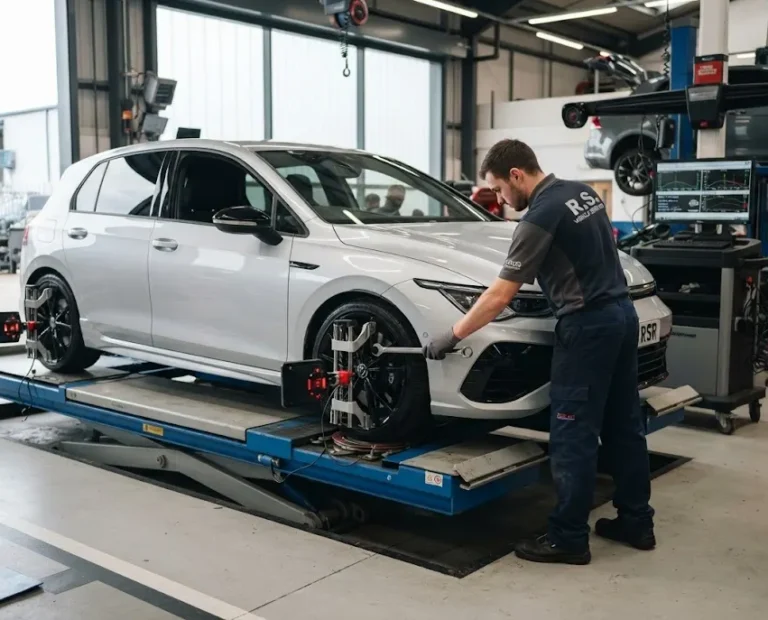
A professional alignment begins with measurements rather than immediately adjusting components. The vehicle is positioned on appropriate equipment, and sensors or targets are used to measure relevant wheel geometry.
The measured values can then be compared with specifications for the vehicle. Depending on the results, the technician may make available adjustments to bring the geometry closer to the manufacturer’s recommended settings.
If the readings cannot be corrected through normal adjustment, the technician may need to investigate worn or damaged components. Alignment equipment can therefore help identify a problem without necessarily being the solution by itself.
How Often Should Alignment Be Checked?
There is no single interval that is suitable for every vehicle. Driving conditions, road quality, suspension condition and vehicle design all influence how often alignment may need attention.
RAC currently advises periodic checks and recommends having alignment assessed sooner when symptoms appear or after events such as significant pothole or kerb impacts.
For motorists, a practical approach is to combine routine observation with professional checks when tyres are replaced, suspension work is completed or steering behaviour changes.
Wheel Alignment as Part of a Maintenance Strategy
Alignment should not be treated as an isolated service. It works best as part of a broader vehicle maintenance strategy that includes tyre pressure checks, tread inspections, brake maintenance, suspension inspections and scheduled servicing.
Regular tyre checks can reveal problems before they become severe. Drivers should inspect tyres for uneven wear and maintain the pressure recommended by the vehicle manufacturer.
When a tyre develops unusual wear, technicians should investigate the underlying cause. Replacing the tyre without addressing a geometry or suspension problem could result in the replacement tyre developing the same issue.
This is particularly relevant for modern vehicles where tyres can be relatively expensive and manufacturers may specify particular sizes, load ratings or performance characteristics.
Choosing a Wheel Alignment Service
When choosing a workshop, motorists should consider whether it has suitable alignment equipment and whether technicians can work with the vehicle’s manufacturer specifications.
It can also be useful to ask what the service includes. Some providers offer front-wheel alignment, while others can measure and adjust geometry across both axles where the vehicle permits.
Drivers should also ask whether the workshop will identify worn suspension or steering components before performing adjustments. An alignment reading that cannot be brought into specification may indicate an underlying mechanical problem.
For motorists using larger garage networks, wheel alignment may be available alongside tyres, servicing and other maintenance. Independent workshops can also provide the service where they have suitable equipment and expertise. This reflects the broader range of automotive service companies available across the UK.
Wheel Alignment and Modern Vehicles
Alignment remains relevant as vehicle technology changes. Hybrid and electric vehicles still rely on conventional tyres, suspension and steering systems, so their geometry needs to remain within appropriate specifications.
The additional weight associated with some battery-electric vehicles can also make correct tyre condition and suspension maintenance particularly important. However, alignment requirements remain specific to the individual vehicle rather than simply its powertrain.
Owners of hybrid and electric vehicles should therefore follow manufacturer recommendations and use a workshop with suitable knowledge of the vehicle. Related maintenance considerations are covered in our guides to hybrid servicing and EV servicing.
Conclusion
Wheel alignment is an important part of maintaining predictable steering, even tyre wear and good vehicle handling. Incorrect geometry can develop after pothole or kerb impacts, accidents, suspension repairs or other changes to the vehicle, although tyre wear and steering symptoms can also have several other causes.
Drivers should pay attention to uneven tyre wear, a vehicle that pulls to one side, an off-centre steering wheel or noticeable changes in handling. These symptoms should be professionally assessed rather than automatically attributed to alignment.
For long-term vehicle maintenance, alignment works best alongside correct tyre pressures, regular tyre inspections, suspension checks and scheduled servicing. A professional workshop can measure the vehicle’s geometry against the appropriate specifications and determine whether adjustment or additional repairs are required.
By treating wheel alignment as part of a wider maintenance strategy, UK motorists can help protect their tyres, maintain predictable handling and identify potential steering or suspension issues before they become more serious.